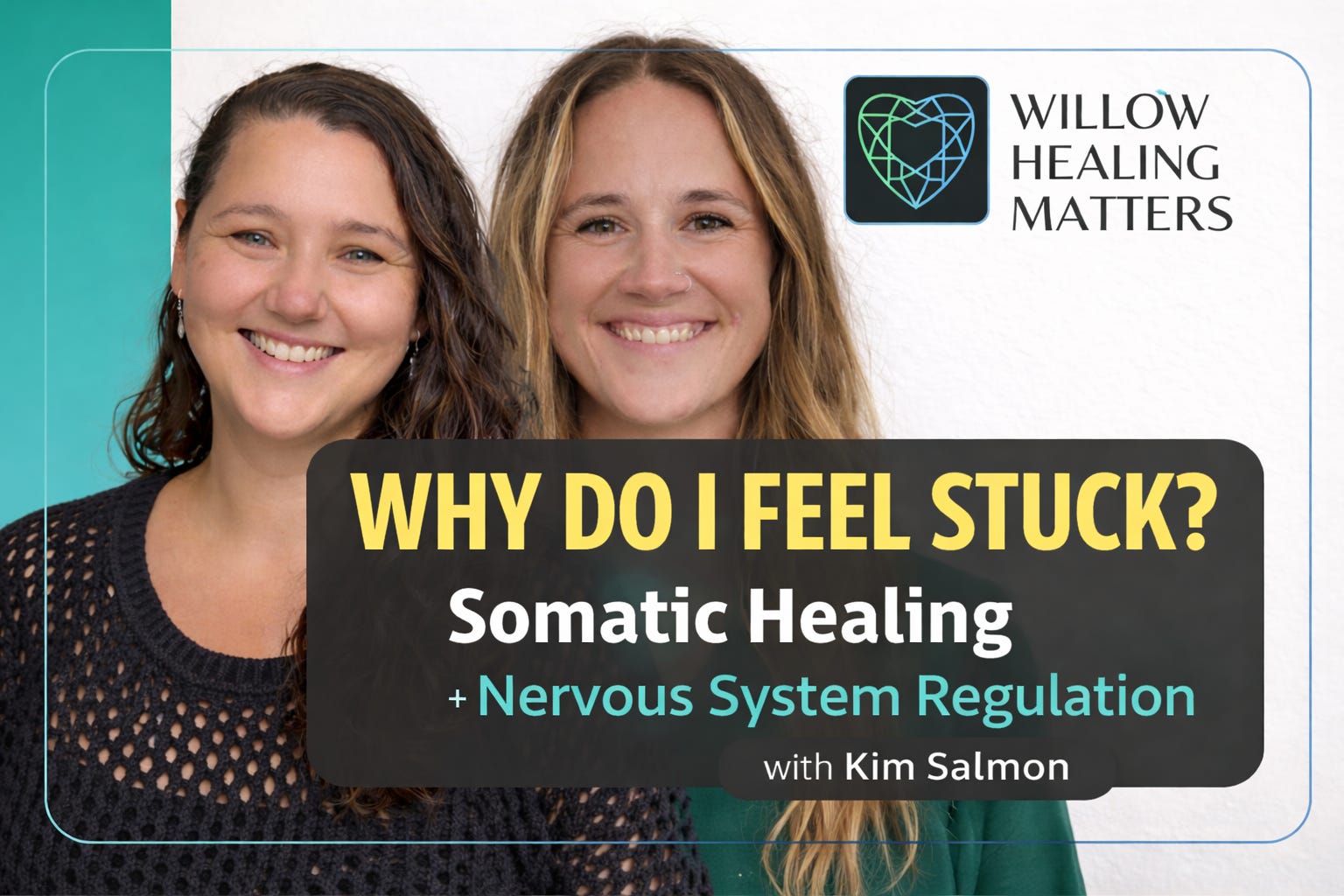
Somatic Healing & Nervous System Regulation: How to Break Free From Feeling Stuck | Kim Salmon
Liner notes
In this episode of Willow Healing Matters, Catherine sits down with somatic healing practitioner Kim Salmon to explore how trauma lives in the body—and how nervous system regulation can help you finally break free from feeling stuck.
Through breathwork, trauma-informed education and somatic awareness, Kim helps clients reconnect with their bodies and move out of survival mode so they can choose the life they truly want.
If you’ve ever felt like the world is against you, like you keep repeating the same patterns, or like traditional talk therapy hasn’t fully helped, this conversation will open your eyes to the powerful role the nervous system plays in healing.
Together we explore:
✨ What somatic healing actually is✨ How trauma impacts the nervous system✨ Why people feel stuck even when they want change✨ Breathwork as a tool for regulation and healing✨ Learning to listen to your body’s wisdom✨ How nervous system regulation creates real life change
About Kim Salmon
Kim Salmon has always known she wanted to help people, but it took her own journey of healing to discover how. Today, she guides clients through somatic healing using breathwork and trauma-informed education on nervous system regulation.
Her work helps people break free from feeling stuck or like the world is against them, empowering her clients to reconnect with their bodies and choose the life they’ve always wanted.
Connect with her on Social Media https://www.instagram.com/kimmys.healingtrails/ https://www.facebook.com/kim.salmon.302805
https://www.tiktok.com/@kimmys.healingtrailsOr her website: https://healingtrailswellness.com/
About Willow Healing Matters
Willow Healing Matters is a podcast exploring healing, consciousness, and reclaiming your inner authority. Through powerful conversations with healers, teachers and change-makers, host Catherine Crestani invites listeners to expand their awareness and reconnect with their truth.
Subscribe for more conversations on healing, consciousness and reclaiming your inner authority.
🌿 Support Your Energy & Go Deeper with Willow Healing Matters
Thank you so much for listening to our podcast 💛
☕ Ceremonial cacao Catherine personally usesPerfect for meditation, ritual, grounding, and heart-led practices discussed in this episode👉 Get here https://creationcacao.com.au/collections/powerful-ceremonial-cacao-at-a-reasonable-price?sca_ref=8943091.vyvJxtUKl7h
📖 My Book Obsession — Catherine Crestani’s virtual book club & reader spaceA slow, reflective way of engaging with stories, intimacy, and consciousness
It is home to Catherine’s novel My Virtual Obsession—a psychological exploration of intimacy, loneliness, desire, and the blurred edges between technology and connection.
✨ The full book is now available, with ongoing reflections and reader discussions inside My Book Obsession🔗 Start here:
🛍️ Books, e-books, courses & offerings:👉 https://www.willowhealing.org
🌿 Explore Willow Healing Matters:Website: https://www.willowhealing.org
Substack:
Instagram: @willowhealingsh
📧 Contact us: [email protected]
This is a public episode. If you'd like to discuss this with other subscribers or get access to bonus episodes, visit willowhealing.substack.com/subscribe
welcome to willow healing matters the podcast we are so excited to have you joining us on this journey where we explore different ways to empower your soul whether it's healing in your kitchen or all the way up in the corporate world come with us
SPEAKER_02: as we look into different ways to heal your mind body and soul My virtual obsession, my romantic thriller, is now available on Amazon and other online retailers. This book explores the intersection of loneliness, love, and how chasing perfection through technology can lead to fantasy and reality colliding. My virtual obsession out now. It's Catherine Cristani with another episode of Willow Healing Matters and today I'm joined by the lovely Kim Salmon. So she has always known that she wanted to help people but it took her own journey of healing to discover how.
SPEAKER_02: Today she guides clients through somatic healing using breathwork and trauma-informed education on nervous system regulation to help them break free from feeling stuck or like the world is against them. She empowers her clients to choose the life that they've always wanted and does this in such a powerful manner. So a big welcome to the show, Kim. Hey, thank you so much for having me. I'm so excited to be here. So I feel the first question is, how did you end up working as a somatic practitioner and what led you down this path?
SPEAKER_02: Like you said at the start of your bio, there was always this yearning. What led you there?
SPEAKER_01: Yeah. So I think just finding it on my own healing journey, I have always known that I wanted to help people. Like I thought about taking a psych degree when I was in high school. I took psychology in high school, loved it, thought about becoming a counselor. But I always knew that I didn't want to sit there and just ask people how like, how do you feel about this? and back then like this was yeah early 2000s so that was kind of what counseling was at that point in time um and i knew that that wasn't my alley but i didn't know what so i honestly just kind of put it on the back burner i was living my own dysregulated life like just thinking i didn't know what i wanted to do or how i wanted to do it and then when covet hit i honestly found my own healing journey started therapy, started doing like finding nature, doing lots of different types of things to heal.
SPEAKER_01: And on that journey, I found somatic healing. So when I found somatic healing, I realized that this was life-changing for me because I had spent like a few years in therapy already, but it was more just talk therapy and that didn't do a lot for me. And I knew like, okay, I have all these, this awareness of these new things that I knew know how to do, but I can't seem to actually change it. And I keep falling back into these old patterns. And once I found somatic healing, which is body-based healing, that's when things started to change for me.
SPEAKER_01: So that's why I decided to get into it because I knew that it was what was going to be life-changing for so many people, including myself.
SPEAKER_02: Which is so beautiful. And I love it when people go through their own healing journey, and then that's how they find the healing practice that resonates with them. And I always think it's spirit working in a bigger way, right? Because how would you end up with a somatic practitioner and then fall in love with it? What were the odds of you picking that, you know?
SPEAKER_01: A hundred percent. And it's so funny, I think, too, because I remember actually just having a conversation with a friend and she was in somatic healing and I didn't know what that was. And I asked her about it and she kind of explained to me and I went, oh, like, I think that would be really helpful for me. And so after that, I went and Googled like somatic therapist. and went into somatic therapy myself and then knew, yeah, this is what I want to do. And then I started researching it all on my own just because I was so passionate about it.
SPEAKER_01: So I really wanted to know about like nervous system regulation, healing trauma, all of that. And so I probably spent 300 hours just like reading books, listening to podcasts, looking up information on Google from those podcasts and books, and then realize, okay, if I'm spending this much time doing it, maybe this is what I'm supposed to be doing. Percent.
SPEAKER_02: But you loved it, right? You loved every moment of it.
SPEAKER_01: Oh, yeah.
SPEAKER_02: And that's when you find the way to turn your passion into a purpose.
SPEAKER_01: Yeah, absolutely. I couldn't agree more with that. So for someone that hasn't experienced somatic work before, what does it involve? So trauma is stored in our body. I'll start with kind of why we do somatic work. Trauma is stored in our body and all of our old energy and memories and a lot of things are stored actually in our body, not in our brain. As well as 80% of information is sent or approximately 80% of information is sent from the body to the brain, not from the brain to the body. So a lot of times people can be in cognitive talk therapy for years.
SPEAKER_01: And again, have all these tools and all this awareness, but not actually seem to change. And they keep falling back into old patterns. And that's often because talk therapy often re-traumatizes you because you're not actually moving the trauma out of your body. You're just talking about it, which then you're reliving it. So with somatic therapy, what we do is we do body-based techniques like breath work, like EFT tapping, different things, dancing even can help that. and it gets the energy out of the body it is really important to partner with things like talk therapy as well but do using both in conjunction with each other can be really really really powerful yeah and it's really beautiful because the guest i had just before you in the last episode she was talking about how therapy helps you get names for the emotions that you might not necessarily understand But then somatic work is that compliment because it's actually feeling those
SPEAKER_02: emotions in your body where you haven't previously allowed it to.
SPEAKER_01: Absolutely. And a lot of the work too is untying the stories you have with those feelings. Like a lot of times, I know you get a feeling in your body, something happens and you get a feeling and it reminds you of something else. I know, I don't know, let's say someone passes you up for, I recently got passed up for a job offer and This was a couple of months ago, but I knew at that time it kind of like made me feel a bit rejected. And that's because that feeling is tied to a lot of other situations in my life where I also felt rejected.
SPEAKER_01: And so through somatic work, we learn to separate the stories in our mind from those feelings in our bodies. So then when we feel those sensations, we don't continue to just create that story like, oh, I'm terrible because I got rejected again. It's just like, okay, no, I'm feeling this activation in my body. And let's move through it without tying a story to it or deciding that we're a certain way because of it. 100%.
SPEAKER_02: And I love how you summarize that. Thank you.
SPEAKER_02: Because it is so often we have events and traumas happen to us and then we use it to define our experience for everything moving forward rather than this just happened to me or happened for me.
SPEAKER_01: Absolutely.
SPEAKER_02: Is the biggest thing.
SPEAKER_01: Yep, absolutely. Absolutely. And I think something too that I didn't know, because I honestly like I grew up, my parents are still married. I they had like we were a middle class family. We traveled when I was younger. I was never like physically abused by them or anything like that. So I think I spent a long time. not thinking that I could have trauma because I'd never had like any really big events that happened to me that were extremely traumatizing. But I've learned on this journey that trauma actually isn't a single event.
SPEAKER_01: It's anything that overwhelms your nervous system's ability to be able to safely complete the stress cycle. So that's why you can see siblings live in the same house, but they have two totally different experiences. One gets traumatized by something and one doesn't is because it's not actually a a specific event, it can be lots of little things that happen. So I think a lot of people may not even realize that they do have trauma because they haven't experienced big events, but then kind of slowly starting to realize like, no, all these little things where I never had my needs met ended up compiling into kind of big traumas.
SPEAKER_02: Yeah, and it can be as simple as I know one of mine was I could never leave shoes at the front door because my mum tripped on shoes that I left at the doorway and sprained her ankle. And it was only years later that I was like, why am I so cranky? about when people leave their shoes at the door. And then when I unpacked that, I was like, oh, right. It's the little seven-year-old version of me creating that thing that there's something bad about doing that.
SPEAKER_01: 100%. It's so interesting once you start to realize those things and then have those memories from when you were a child and really connect it. And I think that's, it's so powerful. It's just, I love it. So passionate about it.
SPEAKER_02: And for someone who's never done a somatic experience before, what can they kind of expect if they were walking into a session?
SPEAKER_01: So I'll give an example with breath work. There is lots of different types of somatic therapy. So I've been in it where I've done kind of a mix of talk therapy and different sessions. So I've done sessions where I've gone with my therapist and we do parts work. So we go back and I meet a younger version of myself as we were kind of just talking about. And then we give it what it needs in those moments. So that's kind of one type that you can do. You can do different types like tapping and whatnot.
SPEAKER_01: Those are all somatic therapies. But with the sessions that I do is mostly breathwork. So I guide you through a guided breathwork session. My mentor likes to say that it's kind of like meditation on steroids. So I never really understood kind of what it was like, but that is a really good explanation for it. To be honest, it's like meditation on steroids and how it works is you're in the comfort of your own home. So the majority of my sessions are online. I also found that like, I used to think that in person was a lot better.
SPEAKER_01: better because we could co-regulate and whatnot, but it takes your body a long time to feel safe in a place that you're not familiar. So by doing it online, you can be in the safety of your own home where your body and your nervous system is more likely to relax and actually be able to open up and release. And so using music and guided cueing, I take you through basically a breathwork journey. So I teach you different breath patterns and we just do continuous breathing to move through the sensations and the feelings that are coming up in the body.
SPEAKER_01: I pair that with Movement and sound as well. So I do encourage movement and sound if the client is feeling that. It can be really beneficial to move the energy out of the body as you're breathing. So like to shake or dance as well as sounding. So I encourage humming or sighing on all of the exhales. and then we go through a guided session it depends if it's a integrative or a meditative integrative the total session lengths are usually about 30 minutes whereas meditative are 60 meditative you can get a little deeper so those ones the guided breath is usually about 40 minutes or so and then we do a drop in and a drop out period because it's really important to also integrate everything that we've learned and whatnot with into our bodies
SPEAKER_02: And I think that's an important piece that a lot of people miss out, the integration, because they'll think often that you'll walk out of a session and it will be instant change, but sometimes it can take weeks, months, if not years, to still integrate what has shifted in your body because if it's a big pattern, it almost just, it's like a continual effect, right? It just keeps shifting and shifting.
SPEAKER_00: Absolutely. Absolutely.
SPEAKER_01: Yeah, absolutely. I actually honestly think I just am starting to shift out of an integration period like that. Like for a couple months now, I've been moving through a lot of old patterns and old emotions, and it's been feeling very stagnant and heavy for quite a while. And it took me a little bit to realize that I was like, oh, okay, maybe I'm in an integration period where everything is just learning to settle and my nervous system is learning a new pattern. The last couple of weeks, that's really proven to be the case.
SPEAKER_01: So it's so true. And it is just having that grace and that compassion that you do need some time to
SPEAKER_02: let the new pattern integrate and that you need that space to let whatever is meant to go go and whatever is meant to come in to replace it to come in.
SPEAKER_01: Yeah. And sometimes you have to remind yourself that that's what's happening and that it's okay and that you're not just like losing your mind. Like I think no matter how much healing work you've done, sometimes it still takes a bit. Like it's like, I don't know, a week or two of me feeling like crap and feeling heavy and crying every day. And then I'm like, why am I feeling like this? You know? And then it's like, oh, okay. Like if I just sit with it for a minute, I can understand it.
SPEAKER_02: Yeah. And I guess it's allowing yourself the permission to feel it too. It's like, okay, well, I'm just going to be sad. You know, I'm just going to be angry. I'm just going to be, I'm just going to be that emotion because it needs attention. you know, and let it come out.
SPEAKER_00: Absolutely.
SPEAKER_01: Yeah. And I think sometimes that can be hard. Like I know for a long time and still sometimes I was scared of certain emotions. Like I'll give anger, for example. I know I've been afraid of my own anger in the past just because it can be a lot. And so I think that's also something to name too is Yeah, you just have to you have to get used to having your own emotions and letting them out and not being afraid of them. And that can that can also take some time. It doesn't happen instantly either. Yeah, because we're so conditioned to box them up, shove them down and just put a happy face on.
SPEAKER_01: 100%.
SPEAKER_02: Yep. Yeah. Especially if you're raised when we were. What's emotional mastery? What do you mean? There's only one emotion we show none or happy. Right?
SPEAKER_01: Yeah. When I cried, it was don't go to your room and don't come out until you're happy.
SPEAKER_02: There's even this song about it. Big girls don't cry. You know, it's like, no, actually, we do. We do cry.
SPEAKER_01: I cry like every day.
SPEAKER_01: And that's okay. It's good. It's healthy for you. It releases cortisol, which is our body's stress hormone. So it's our body's, again, it's our body's own way of deregulating ourselves and down-regulating ourselves when we're dysregulated because it actually releases cortisol, which is the body's stress hormone. And I feel that like a powerful thing too is the more you step into this work,
SPEAKER_02: whether it's somatic work, breath work, whatever, whatever form of healing you're choosing, the more that you start to stop yourself from going into old states where you would go into the spirals or you'd go into the nervous system, shut down and get to the freeze point. Because the more you learn these and learn that there's a different state you can be in, the more you have the power to choose to pull yourself out of it.
SPEAKER_01: Yes, 100%. And also to
SPEAKER_01: like the less time you spend there. Cause of course you're still gonna get dysregulated. Things are gonna happen. Life is life is life. Life is hard. Things happen in life every day that are gonna throw you off, you know? And I think it's also about yes, choosing differently. And coming back from it quicker too. Like that's the other things. Things would use to dysregulate me for days and I would just be, yeah, on it, frustrated, ruminating over it for days. And now it's like sometimes within minutes I can be like, okay, no, I'm frustrated.
SPEAKER_01: I'm going to feel that. And I'm, cause I am angry and it's important to feel those emotions, of course. And then it's like, okay, now I can, I can release it because it's not the end of the world.
SPEAKER_02: A hundred percent. And I, sometimes we just need to entertain the emotions or entertain the thoughts or the feelings, but in a healthy way that we don't get sucked in and we can allow it to come out. Cause sometimes our ego just wants the attention and acknowledgement.
SPEAKER_01: That's often what it wants. Like it often just wants the validation and for you to be able to express those emotions in full. Cause like we often just hide it or suppress it or don't feel safe to allow them out. Right. So.
SPEAKER_02: Yes. Yes. Full stop. And I, and I guess too, as people step more into being aware of that, what are some signs that their nervous system might be in dysregulation?
SPEAKER_01: Tense or irritable all the time. Like if you're feeling tense or irritable most of the time and you don't know why that can be a good indication. I know, for example, like before I kind of started my healing work, I used to, Like people would be like, oh, how are you today? When I would go to work and I would just be like, I don't know, I'm just annoyed today. Like I woke up on the wrong side of the bed and I wouldn't know why. And I just that was just my life, like almost every single day. And as I started my healing work, it was like, oh, OK, no, that was because I was so dysregulated that.
SPEAKER_01: I was actually just irritable all the time because I was dysregulated,
SPEAKER_00: you know,
SPEAKER_01: but I didn't actually know it at the time. If feeling numb, like if you feel hard to feel emotions, sometimes being like having too many emotions, so not being able to have control of them. Reacting without thinking a lot of times. It's funny because I have ADHD and I feel like a lot of these symptoms are also ADHD symptoms. But it's crazy how much... Sorry, I'm going to go on a little tangent with ADHD there. It's crazy how much since I've started regulating myself that I've noticed my ADHD symptoms drop.
SPEAKER_01: So a lot of these things that I'm talking about, like reacting without thinking, feeling numb all the time, having too many emotions... struggling to relax can be another one so if you never feel like you can have any downtime that can be a sign of dysregulation and i think for a lot of people with adhd those symptoms can also dissipate once you regulate yourself as well i i read this thing that people with adhd just perceive timelines differently it's almost
SPEAKER_02: like they can see multiple things happening at once And the difficulty is shifting their focus so that their nervous system can be in the moment.
SPEAKER_01: 100%. Yeah. Yeah.
SPEAKER_02: Yeah. I can, I can attest. I can confirm with that one. And I feel that's such an important point you bring up to Kim is that when you regulated your nervous system, a lot of the symptoms disappeared.
SPEAKER_01: Yeah, absolutely. Which I never expected either. And I think. A lot of symptoms of ADHD are similar to a lot of symptoms of dysregulation. Like you're treating every day like it's an emergency. So kind of always feeling like everything has to be rushed, constantly feeling on guard, things like that. Those are all symptoms of dysregulation. So regulating your body can help you even come to realize like, oh, I've been like, I lived my life on autopilot for so long and I didn't even realize like I would drive from work to home and then I would get home and I'd be like, I don't even remember that drive.
SPEAKER_01: And it's often because you're just on autopilot and you're just disassociated. You're not even paying attention to it. And now it's like, I often drive down the street and I'm like, look at that pretty like tree or look at that bird flying. And it's just like being present and bringing yourself into the present moment. And it's yeah. Yeah. Yeah, and I think that's such an important thing for anybody is just learning that gift
SPEAKER_02: of presence because it's when we go into the future that we worry. It's when we get stuck in the past that we have regrets. So if you can just learn to be in that present moment, it takes you out of a lot of the ego-driven thoughts that create the patterns that make you anxious in the first place or make you feel overwhelmed and need to bounce off the walls like Tigger from Winnie the Pooh. Yeah. yes yeah absolutely couldn't have said that better to be honest i used to use with parents this beautiful analogy of how to explain adhd verse add verse um being regulated but now i see it as like a way to explain the nervous system so you've got winnie the pooh right he's pretty chill not much phases him but he's there he's present then you have eeyore yeah everything's too hard that's your freeze right that's your add that's your freeze absolutely and then you've got tigger who's bouncing all over the walls with a i'm tigger with adhd and in fight and flight constantly because he can't regulate his nervous system and it was just such a beautiful thing that came to me love this oh
SPEAKER_00: my god it's so true it's so true i never yeah it's so true yeah But in terms of us that grew up watching Winnie the Pooh, it makes so much sense. You're like, oh, yeah, Ewell was always a sad sack and everything was too hard.
SPEAKER_02: And it was just like, I don't want to get out of bed today. That's your freeze. That is when you're in that freeze moment. Versus Tigger, who's bouncing off your walls, who's constantly anxious, overwhelmed, stressed, like happy about it, but like really, really full on happy about it. And then you've got Pooh like, oh, bother. Okay, let's just move along.
SPEAKER_01: Yeah. exactly yeah oh my god it's so true i love that so much i might i might end up using by all means to be honest i might have and i'll be honest i don't know if someone else is relatable yeah i don't know if someone else i remember someone teaching me the difference between adhd and add as tigger versus eeyore but i think i just added the winnie the pooh component and just put the whole spectrum in there
SPEAKER_02: for everybody
SPEAKER_01: That's fair. That's totally fair. I don't know about in Australia, but here in Canada, they and I don't maybe the US as well. They've actually like they don't separate them anymore. So it's all just like combined as ADHD. So they've moved ADD into ADHD. So they just call it all encompassing ADHD now, basically. Just to confuse. That's good because then you don't have to like try and separate because I think like ADD was more inattentive and ADHD was more hyperactive. But now they realize that a lot of people have both.
SPEAKER_01: So like I definitely have both for sure. And so I think that's kind of why it's like, okay, it's actually one. There's just like different spectrums of it, of course.
SPEAKER_02: Also, the amount of clients I had that were diagnosed with the wrong form of it because the doctor didn't even understand. And I'm like, yeah. A child does not have hyperactive ADHD. And they're like, what do you mean? I said, this is the difference. And I give the Winnie the Pooh analogy. And they're like, oh, yeah, my kid's definitely the ear. Yeah. Right? That's hilarious. But this is how, you know, there's so much confusion as well and lack of understanding. And even, you know, imagine if they brought somatic practices into school, how different the classrooms would look.
SPEAKER_01: Oh, it would be amazing. I actually, it's funny that you mentioned that. So I actually did last year, I went into a high school and I did a breathwork session for one of the dance classes. I think it might've been a yoga class actually, because I heard they have here, at least they have yoga as an elective in high school. So the teacher was also a dance teacher and Um, and she knew my cousin somehow. So we, we got put in touch and she asked me to come and do a breathwork session. So I did a complimentary breathwork session.
SPEAKER_01: Um, and it ended up being really cool because it was actually my old high school and I really struggled as a teenager, really still like that was definitely when I had a lot of my learning years was as a teenager. Um, and so it was a really big full circle moment for me to be able to go back into the school where I had so many struggles and teach students about breathwork and about how they can change their lives at their age. And so, yeah, it would be, it should be in every single school.
SPEAKER_02: Well, we'll create this new system will be okay.
SPEAKER_01: Yeah, absolutely. 100%.
SPEAKER_02: 100%.
SPEAKER_01: But yeah,
SPEAKER_02: especially in high school, like we go through so much things as we deem as big traumas with their really little traumas, but it's just the compounding. And we didn't even have half the tech that they have now, right? Like this is just Like I had MSN chat and was it ICQ? I'm showing my age now, right?
SPEAKER_01: MSN, when you would say BRB because you were going to the bathroom.
SPEAKER_02: Be right back. I'll be right back. Two minutes. Yeah, exactly. And you could change the little status so people knew that you were away. And for anyone listening who is significantly younger than us, back in the days when it cost 25 cents to send one message, we had this thing called Skype and ICQ and MSN chat. And then you would message people, you would actually connect with more strangers and I guess maybe now in retrospect, it was a little bit dangerous. But at the same time, you would use this acronym called ASL and it meant age, sex and language.
SPEAKER_02: And you would just talk to strangers from around the world and you just meet new people and make friends. And it's actually interesting because there's this whole, you know, like, aspect of cyber safety and stuff like that for children but we we're not very good at talking to strangers anymore right like it's people find it really difficult to have an honest conversation with you that's not about the weather or something really boring that you don't want to talk about and i feel it's because everyone's nervous systems are in such dysregulation no one feels safe enough to actually be themselves
SPEAKER_01: It's so true. Yeah. I couldn't agree more with that. I honestly, it's interesting because I personally don't have that experience because I have a lot of conversations with like strangers and deep conversations, philosophical conversations, but I noticed that's not the case for a lot of people. And I think it is, we're all just so scared of connection and we're all just so dysregulated. And I think a lot of us are like, like, I know for me, is I spent a long time worried about what other people thought.
SPEAKER_01: So I would think like, oh, they're going to think of this about me. Are they going to think that about me? When in reality, we're all dealing with all of our own things. Like I know that if somebody else is sitting there when I'm like, I don't know, in the gym with them, like they're like, oh, she's going to be thinking I'm doing this wrong. I'm in my own head thinking that I'm doing it wrong. And this other person's probably in their own head being like, oh, this shirt looks too tight on me today.
SPEAKER_01: And it's like, you know, I think we think like a lot of times everyone's going to judge us or things like that. But it's like everyone's just living their own lives and they're more worried. Everyone thinks a lot more about themselves than they think about other people. So with those kinds of things.
SPEAKER_02: Definitely. And this is just everyone's different stages of regulation. But the safer you feel, the more you're happy to have those deeper conversations with people. And you also attract those people because then they feel safe with you. Because they like, oh, I like her energy. You know, it feels like a safe place. I can have that conversation.
SPEAKER_01: And subconsciously, our nervous systems like co-regulate with each other. So it's like if you've ever walked into a room and there's somebody in there and instantly you feel on edge and you're just like, you know, when you're around these people, a lot of times you often feel like you're like, oh, I just feel tense or like I can't like fully be myself or fully relaxed. and then let's say you've gone into another room with someone i don't know like maybe at the grocery store and the cashier just absolutely makes your day they're like hey how have you been like it's a beautiful day outside today isn't it you know and you just leave feeling like oh my god like that was such a great like interaction and conversation that's likely because the first person's nervous system was very dysregulated and your nervous system is picking up on that and then the second person's nervous system was regulated and so your nervous system is co-regulating to that and becoming more regulated because of it.
SPEAKER_01: So it's really cool. It's a lot of regulation.
SPEAKER_02: But it's so true. It's like that whole thing. You never know if a smile can change somebody's day, right? Because it could just be that glimpse of energy and that kindness part. And even there's a gaming shop near us and one of the employees there, he is always so happy and animated and nothing's too hard. And I actually commented to him. He's like that every time you go in there, every time. And I actually said to him, we were paying for something. And I said to him, thank you for being so animated and just loving life.
SPEAKER_02: And he's like, oh, thank you. Like he just was. But I don't want you to stop. And I want you to know that this, your cheery, happy disposition is actually really beautiful, you know, because it's not.
SPEAKER_01: Yeah, absolutely. You know. Percent. No, I knew some people don't even realize. I don't think like he probably didn't even realize that that's how he made people feel. It's like, I think, yeah, yesterday, actually the same kind of thing. I was driving down the road and I drove past this person that was, the people listening won't be able to see, but they were just dancing in their car, pointing their each finger up like this, like, and just jamming. And I just saw them for like three seconds. And I literally said out loud, holy crap, that guy just made my day.
SPEAKER_01: Cause I was just like, so I could literally like feel his energy just driving past him because he was like so happy and out there. And it's, yeah, I think a lot of people too don't realize how much impact you can have on other people and how much you probably already have on other people without you. Yes.
SPEAKER_02: Even knowing a hundred percent, a hundred percent. And as we start to finish our time together, Kim, I asked the guests that come on the show, if you could heal or change something in the world, what would it be? this is a hard one if i could heal or change something i would want everyone to understand nervous system regulation because i think if everybody in the world understood nervous system regulation the entire world would be different 100 we would be living a whole different universe no egos clashing with other egos yeah yeah right Yeah, definitely.
SPEAKER_02: And if people want to come connect with you, Kim, or find out about your offerings, where can they go?
SPEAKER_01: They can find me pretty much on any social media. I'm on Instagram under Kimmy's.healingtrails. I'm on Facebook under my name, Kim Salmon. TikTok and threads, I'm on there as under Kimmy's Healing Trails as well. And then my website is healingtrailswellness.com or .ca. Both of them will take you to the same place.
SPEAKER_02: Beautiful. And I'll make sure to put all those details in the show notes so everyone can connect with you. Kim, thank you for giving us insight into somatic work and the different ways it can show up as well as our nervous system and how important it is to regulate it for everyone watching listening please feel free to subscribe like or share because sharing is caring and it helps get our messages out into the world and we truly do appreciate it so thank you kim for being on the show truly appreciate you being here thank you for having
SPEAKER_01: me i had such a great time Are you looking for an afternoon boost to support you until the children go to bed
SPEAKER_02: or to get through that evening meeting? Why not reach for a cup of ceremonial cacao? It will boost your energy, reduce your inflammation and also allow you to go to sleep at a decent hour. For more information on how to grab your ceremonial cacao, check out the link in the show notes for 10% off. Thank you for listening to Willow Healing Matters, the podcast. We have so much love and gratitude that you are taking the time out of your day to empower you on your healing journey. The views shared by the person being interviewed might not necessarily reflect that of the host and should be used in your own discernment.
SPEAKER_02: Trust what resonates with you and follow your heart and soul guidance. If you have any underlying medical conditions or mental health issues, please consult with your healthcare provider before pursuing any of the recommendations. Likewise, you can always contact the person being interviewed to find out more information. This can be found in the show notes. Remember to activate, align, heal, empower, and find love in everything that you do.
 Apple Podcasts
 Castbox
 Castro
 Goodpods
 Moon FM
 Overcast
 Pocket Casts
 Podbean
 Podcast Addict
 Podcast Republic
 Spotify